Here we show that the snake venom α-bungarotoxin is an antagonist of GABAA receptors
The snake neurotoxin α-bungarotoxin (α-Bgtx) is a competitive antagonist at nicotinic acetylcholine receptors (nAChRs) and is widely used to study their function and cell-surface expression.
.
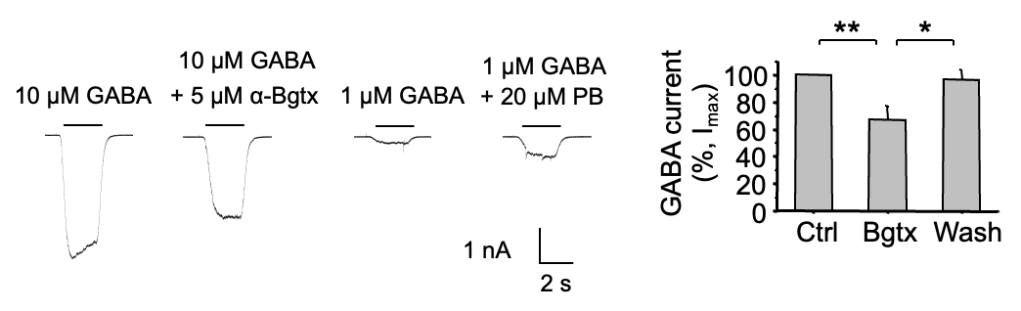
Bungarotoxin inhibits GABAA receptors in hippocampal neurons
α-Bgtx can antagonise GABA-activated currents in neurons
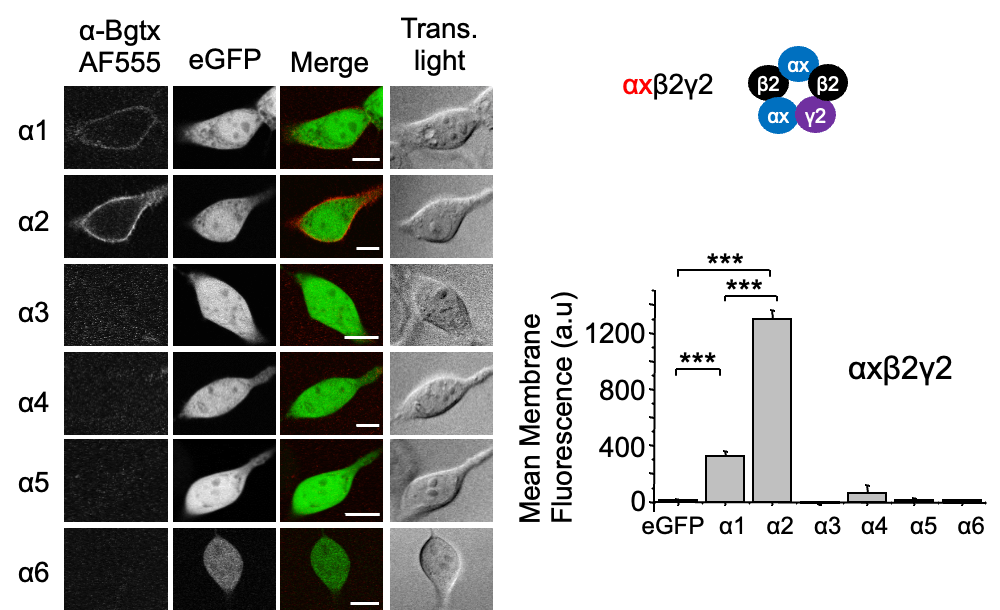
Bungarotoxin binds to a subset of recombinant GABAA receptor heteromers
We investigated the binding of α-Bgtx coupled to Alexa-Fluor 555 (α-Bgtx-AF555) to cell surface receptors expressed in HEK-293 cells composed of an α subunit (α1-α6) with either β1γ2 or β2γ2 subunits. Of these combinations, α2 subunit-containing receptors demonstrated the highest cell surface staining with α-BgTx-AF555. Receptors containing α3/5/6 subunits and β1/2γ2 did not show any labelling with α-BgTx-AF555.
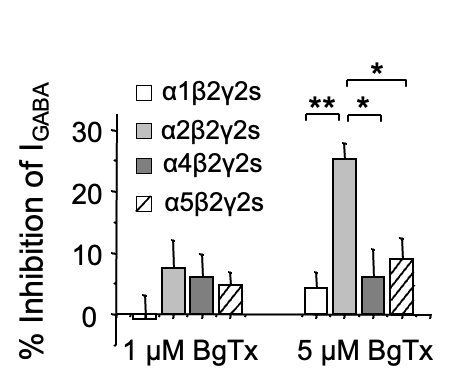
Bungarotoxin selectively inhibits α2 subunit-containing receptors
GABA currents at all GABAA receptor subtypes examined were inhibited by the highest concentration of α-Bgtx tested (20 μM), with currents mediated by α2β2γ2 showing the most inhibition, and α5β2γ2 the least.
At lower concentrations of α-BgTx (5 μM) however, inhibition was only observed at α2β2γ2 receptors.
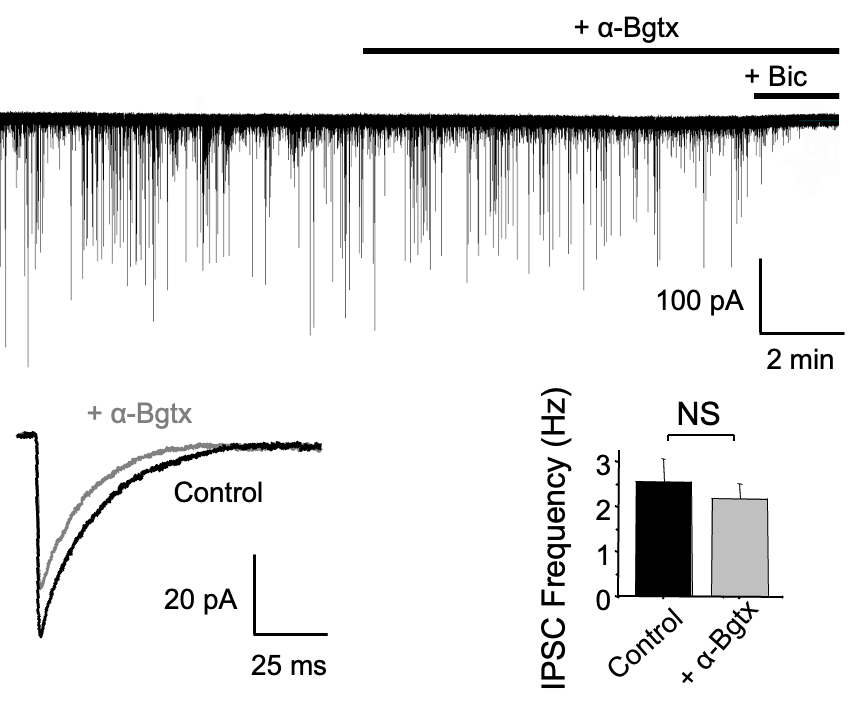
Bungarotoxin inhibits only phasic GABA currents in dentate gyrus granule cells
In dentate gyrus granule cells α-Bgtx reduced IPSC amplitude but not frequency suggesting that α-Bgtx inhibits endogenous synaptic GABAARs in acute hippocampal slices.
 Saad Hannan