CGP7930, the first GABAB receptor positive allosteric modulator (PAM) reported in literature, is the most widely used GABABB PAM with over 50 studies using this compound.
CGP7930 has high structural resemblance to the GABAA receptor positive allosteric modulator and intravenous anaesthetic propofol.
Worryingly, we show that CGP7930 is more potent modulator of GABAA receptors and also K+ channels
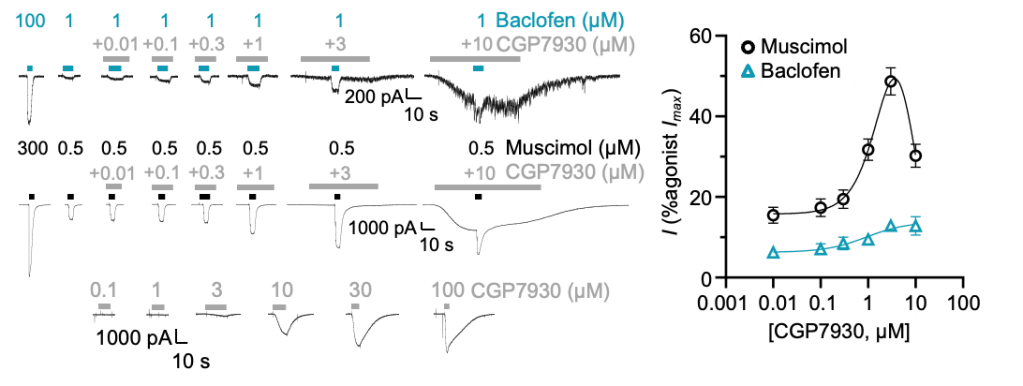
CGP7930 is a potent postive allosteric modulator of GABAA receptors
CGP7930 potentiated GABAA receptor currents in neurons and HEK-293 cells. At high concentrations, CGP7930 directly activates GABAA receptors and proceeds to inhibit these ion channels as concentration is increased.
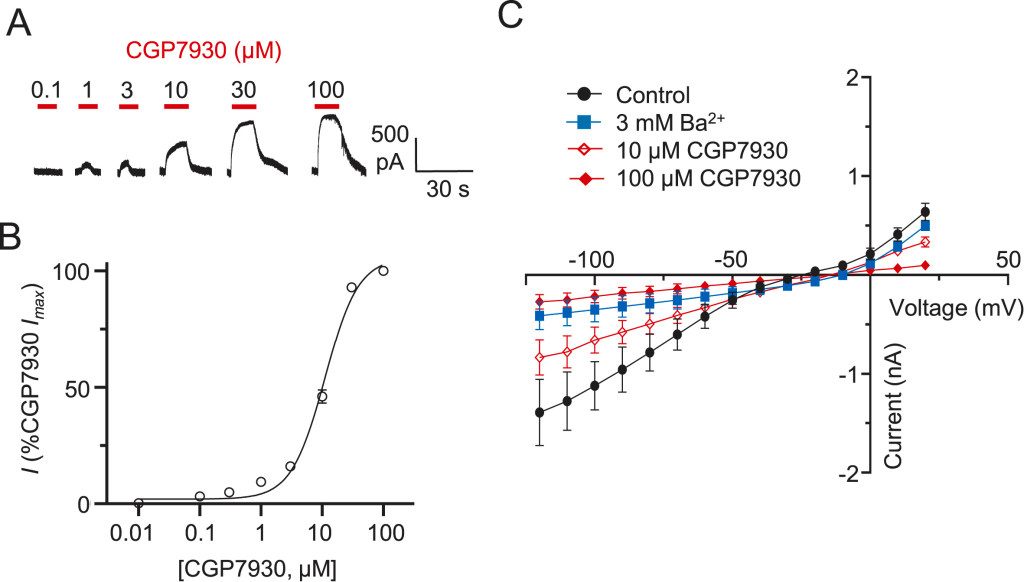
CGP7930 is a K+ channel inhibitor
Applying 10 mV step changes revealed GIRK-mediated inwardly-rectifying currents between −20 and −120 mV. Application of 10 or 100 μM CGP7930 caused inhibition of these currents, a feature also seen with the inward-rectifier blocker, Ba2+ applied at 3 mM.
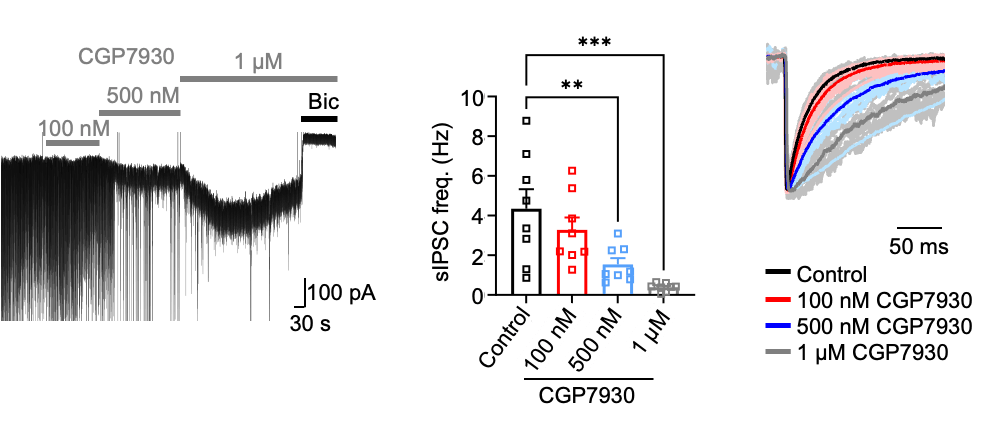
CGP7930 reduces sIPSC frequency and the decay rate for GABAergic sIPSCs in hippocampal neurons
Applying 0.1, 0.5 and 1 μM CGP7930 reduced sIPSC frequency in a concentration-dependent fashion.
Characterising the effect of CGP7930 on the kinetics of sIPSCs in hippocampal neurons also revealed prolonged sIPSC decay times in a concentration-dependent manner compared to control
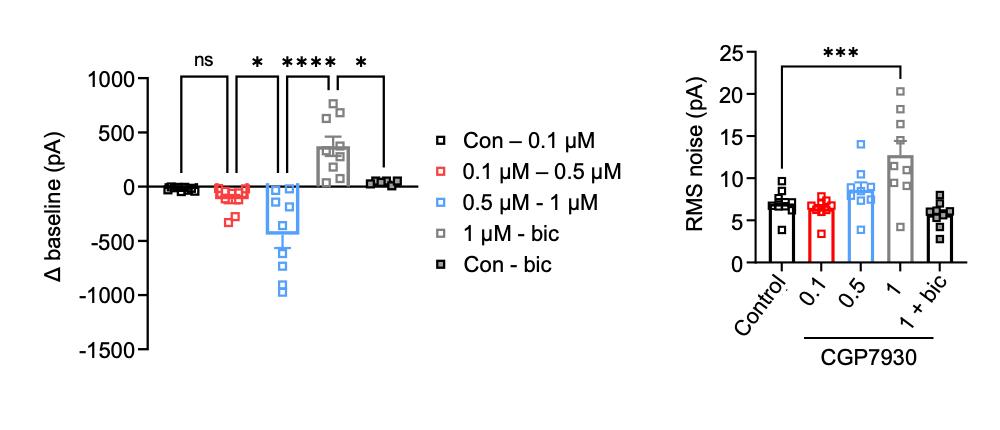
CGP7930 increases tonic inhibition in hippocampal neurons
Application of CGP7930 caused a concentration-dependent increase in baseline holding currents and bicuculline reversed the 1 μM CGP7930 increase in tonic current back to control levels.
The CGP7930-mediated increase in tonic current occurred concurrently with increments in the root-mean-square for membrane current variance. This was also concentration-dependent and reversed by 50 μM bicuculline.
For more details please visit the publication:
*co-corresponding author
 Saad Hannan