What are the mechanisms by which GABAA receptor variants cause seizures and developmental anomalies?
Reduced efficacy of GABA inhibition has long been associated with developmental and epileptic encephalopathy phenotypes.
Here we studied an α1 truncation variant GABAA receptor that underlies severe developmental and epileptic encephalopathy identified by our collaborators in Germany.
Our results reveals that disease-inducing variants can affect GABAA receptor structure, and consequently subunit assembly and cell surface expression, critically impacting on the efficacy of synaptic inhibition, a property that will orchestrate the extent and duration of neuronal excitability.
The proband and approach
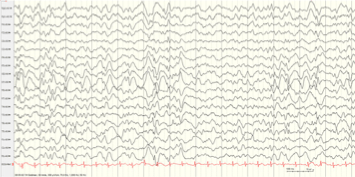
As a result of the intractable epileptic encephalopathy, the individual carrying the variant c.1200del, p.(Lys401Serfs*25) in GABRA1 was regularly seen at the pediatric neurology clinic (as an outpatient) in Erlangen.
EEG monitoring was performed by an experienced paediatrician trained in neurophysiology and epileptology using standard investigative practice and established procedures. Informed written consent for publication of this clinical case was obtained from the legal guardians, and publication of the updated clinical course is covered by the ethical vote for retrospective translational research studies under the auspices of the Ethical Committee of the Medical Faculty of the Friedrich-Alexander-Universität Erlangen-Nürnberg.
We characterised the molecular pharmacological properties of disease variant GABAA receptors in heterologous expression systems (Xenopus oocytes and HEK-293T cells) and neurons using electrophysiology, flow cytometry, and imaging.
Variant receptors have reduced GABA sensitivity
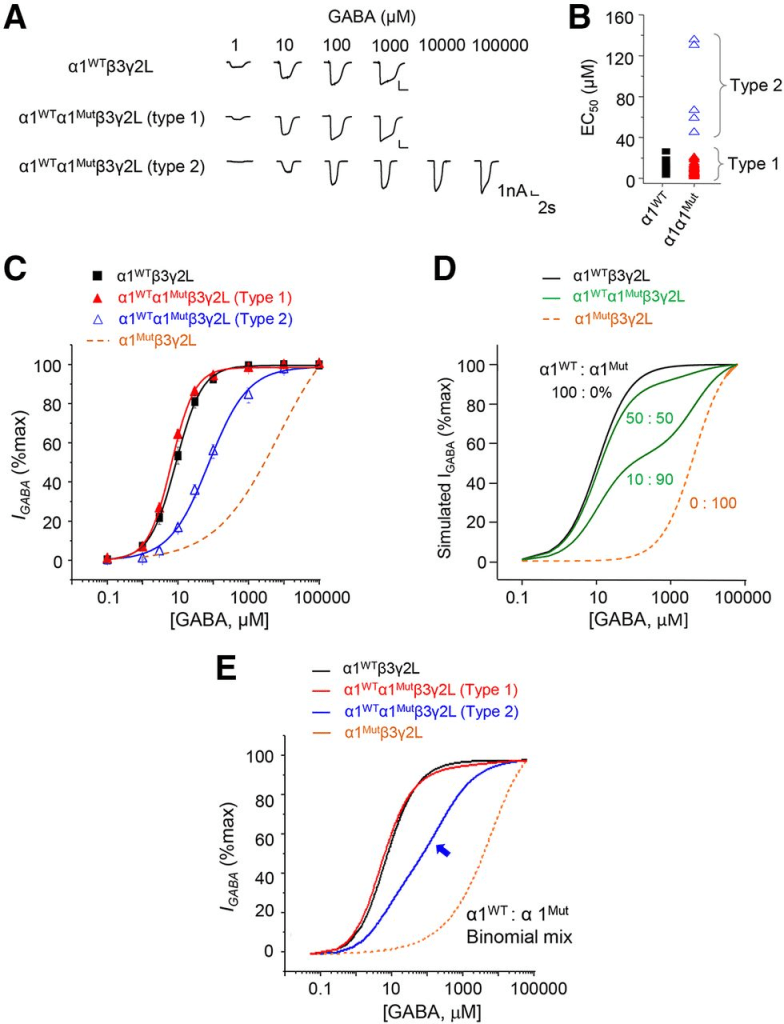
Expression of variant receptors and their characterisation in HEK-293T cells and Xenopus oocytes confirmed impaired GABA activation, gating, and GABA sensitivity and provided the first evidence that their expression and signaling properties depended on co-assembly and/or trafficking with different β subunits in mammalian cells.

Variant receptors are severely compromised in cell suface expression due to ER retention
Expression of variant receptors in neurons revealed severely compromised cell surface expression.
In HEK-293T cells variant receptors were retained in the endoplasmic reticulum at high quantities.

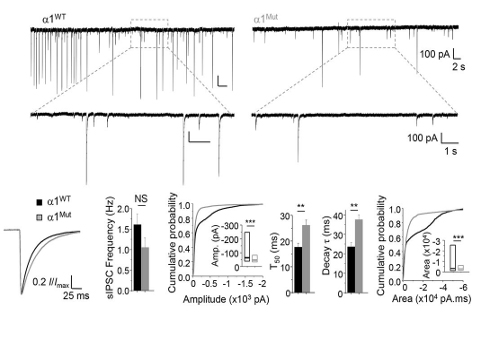
Epilepsy-inducing α1 variant impairs GABAergic neurotransmission
Expression of α1 variants in hippocampal neurons reduces the amplitude of inhibitory postsynaptic currents (IPSC) and prolongs the kinetics of the spontaneous IPSC waveforms
Evidence for α1 tri-heteromeric GABAARs
Using a combination of mathematical modelling, mutant expression studies in cell lines and characterisation of biophysical properties of receptors, we provide evidence of mutant subunit assembly with wild-type receptors as a mechanism for GABAA receptor signaling deficits for the first time in neurodevelopmental disorders.
For more details please visit the publication:
*corresponding authors
 Saad Hannan