Activation of glutamate receptors recruits GABAB receptors to presynaptic terminals to apply brakes on excitatory neurotransmission
GABAB receptors are class C G-protein coupled receptors (GPCRs) that prevent glutamate release by inhibiting voltage-gated Ca2+ channels. Concentration of GABAB receptors at presynaptic terminals is a crucial determinant of the efficacy of presynaptic inhibition via these receptors.
Here we uncover that activation of NMDA receptors recruits GABAB receptors at presynaptic terminals to limit neurotransmitter release. This signaling cascade suggests how synaptically released glutamate can initiate, via a feedback mechanism, increased levels of presynaptic GABABRs that limit further glutamate release and excitotoxicity.
The approach
Using single particle tracking of quantum dots, we show that GABAB receptors are recruited to presynaptic terminals by lateral diffusion

NMDAR activity recruits GABAB receptors to axon terminals by slowing their mobility
GABAB receptors are able to access presynaptic terminals by lateral diffusion.
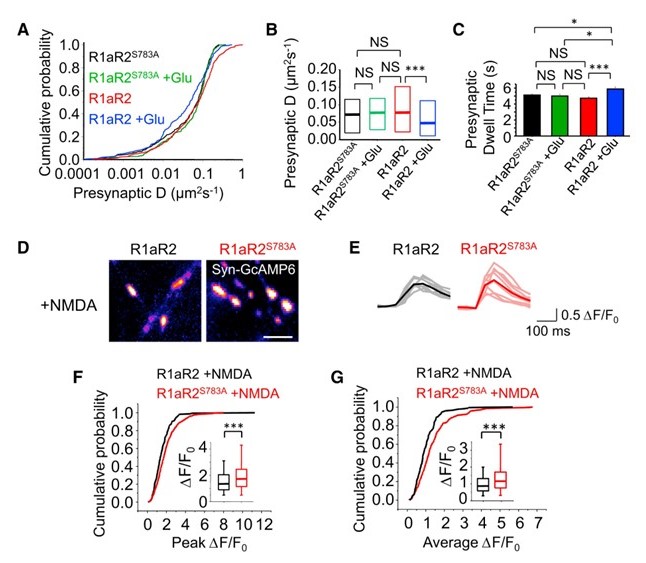
Activation of NMDA receptors slows down lateral mobility of presynaptic and increases their synaptic residence times.

GABAB receptor accumulation depends on intracellular Ca2+ and phosphorylation of GABABR2S783
Following brief activation of NMDA receptors using glutamate, GABAB receptor diffusion is reduced, causing accumulation at presynaptic terminals in a Ca2+-dependent manner that involves phosphorylation of GABABR2 subunits at Ser783.
Model of GABAB receptor lateral mobility mediated brake on glutamatergic neurotransmission
Pre- or postsynaptic NMDA receptor activation would initiate Ca2+ influx via NMDA channels and, eventually, either directly or by retrograde transmitter release , increase terminal Ca2+ levels following Ca2+ channel activation and/or by internal Ca2+ release.
In terminal membranes, this would initially increase glutamate release but also enable AMPK activation to phosphorylate S783 on R2 subunits, slowing GABAB receptor mobility in the terminal membrane and promoting receptor accumulation to increase presynaptic inhibition once GABAB receptors are activated.

 Saad Hannan